
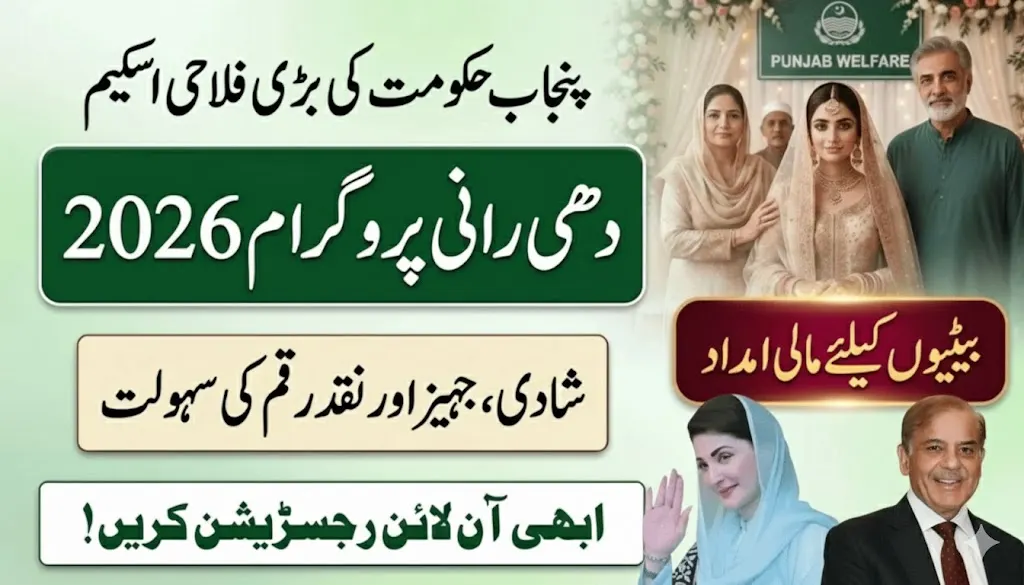
The Punjab Government has launched the Dhee Rani Program 2026 under Chief Minister Maryam Nawaz Sharif’s leadership, establishing a comprehensive welfare initiative that addresses one of the most significant financial challenges facing low-income families—marriage expenses for daughters. This program combines financial assistance, dowry support, collective wedding arrangements, and legal protections into a single integrated package.
For families struggling with the mounting costs of wedding ceremonies and household setup, this initiative offers substantial relief while ensuring dignity and transparency through modern digital systems.
Understanding the Punjab Dhee Rani Program 2026
The Dhee Rani Program 2026 represents a government-backed collective marriage scheme specifically designed to support girls from vulnerable and disadvantaged backgrounds. The initiative recognizes that wedding expenses often create severe financial hardship for poor families, sometimes leading to debt, delayed marriages, or exploitation.
By providing comprehensive support through a transparent, digitized process with biometric verification, the program eliminates traditional corruption risks while ensuring assistance reaches genuinely deserving families. The collective ceremony format maintains dignity while dramatically reducing costs that families would otherwise bear alone.
This isn’t just about one-time financial help—it’s about creating social protection systems that empower women and strengthen families during critical life transitions.
Read Also: CM Free Solar Scheme 2026 Result Announced
Target Beneficiaries and Program Scope
The program prioritizes daughters from specific vulnerable categories where need is most acute. Girls from low-income families who cannot afford traditional wedding expenses form the primary beneficiary group.
Orphan daughters who lack parental support receive special consideration, recognizing their particularly difficult circumstances. Girls with disabilities face additional barriers and discrimination, making them priority candidates for program support.
Daughters whose parents have disabilities often shoulder caregiving responsibilities while living in poverty, qualifying them for assistance. The program also extends to destitute or socially vulnerable households where daughters face uncertain futures.
Beyond marriage support, the program includes long-term welfare initiatives for newborn and young girls, creating protective frameworks that extend throughout childhood and into adulthood.
Core Program Objectives
The Punjab Government designed this initiative around several interconnected goals that address both immediate needs and systemic issues. Providing financial relief to struggling families alleviates the crippling burden of wedding expenses that can trap families in poverty for years.
Ensuring dignified marriages through collective ceremonies removes the shame and social pressure that often accompanies financial hardship. Families participate in properly organized events that maintain cultural traditions while eliminating excessive spending.
Promoting women empowerment and social inclusion means giving daughters from disadvantaged backgrounds the same opportunities for proper marriages as their wealthier peers. This levels the playing field and challenges class-based discrimination.
Preventing exploitation through mandatory legal marriage registration protects brides from informal arrangements that leave them vulnerable. Every marriage conducted through the program receives proper NADRA documentation, creating legal protections and establishing rights.
Guaranteeing transparent selection via digital verification eliminates favoritism, bribery, and political interference that plagued earlier welfare programs. Computerized systems ensure only eligible families benefit.
Comprehensive Financial Benefits Package
The Dhee Rani Program 2026 offers one of Pakistan’s most generous marriage support packages, with total value exceeding Rs. 300,000 per bride when all components are calculated together.
Essential Dowry Package
Each selected bride receives household items worth over Rs. 206,000, carefully chosen to provide everything needed to start a new home. The package includes a Holy Quran and prayer mat for spiritual foundation, recognizing the religious importance of marriage.
Furniture essentials include a wooden double bed with quality mattress, ensuring comfort and durability. A dressing table with mirror provides necessary grooming space. Complete dinner sets and kitchen utensils enable the new household to function independently from day one.
Additional household essentials cover daily living needs, from linens to storage containers. Every item is practical and selected based on feedback from previous program participants about what newly married couples actually need.
Direct Cash Support
Financial assistance ranges from Rs. 100,000 to Rs. 200,000, depending on individual circumstances and program budget allocation. This cash gift, known as salami in local tradition, is transferred directly via ATM card to prevent misuse or theft.
The card-based system ensures transparency—funds go directly to the bride rather than intermediaries. Recipients can withdraw amounts as needed, providing flexibility for immediate expenses or savings for future needs.
Government-Organized Wedding Ceremonies
Families participating in collective weddings avoid the crushing expense of hall rentals, catering, decorations, and event management. The government handles all arrangements, ensuring events are dignified, culturally appropriate, and properly organized.
These mass wedding ceremonies accommodate dozens or hundreds of couples simultaneously, creating festive atmospheres while distributing costs efficiently. Families simply attend without worrying about logistics or expenses.
Dowry items and ATM cards are distributed during the ceremony itself, ensuring accountability and public transparency. This public distribution also prevents items from being diverted or replaced with inferior products.
Legal Marriage Registration
Every marriage conducted through the program receives official NADRA registration, creating legal documentation that protects both spouses. This registration establishes inheritance rights, enables spousal benefits, and provides legal recourse if disputes arise.
Many poor families skip formal registration due to fees and bureaucratic complexity. By including this automatically, the program ensures vulnerable brides have legal protections that might otherwise be denied.
Detailed Eligibility Requirements
Applicants must satisfy several specific criteria to qualify for program benefits. Understanding these requirements helps families determine eligibility before applying and ensures proper documentation is prepared.
Bride-Specific Criteria
Female applicants must fall within the age range of 18 to 40 years, ensuring they’re adults legally able to consent to marriage while remaining within typical marriage age ranges. This protects against child marriage while accommodating women who may have delayed marriage due to circumstances.
Unmarried status must be verified through sworn affidavit, preventing program abuse by those already married seeking additional benefits. This affidavit carries legal weight and false declarations face prosecution.
Priority categories include orphans who lack parental support, destitute individuals without family resources, persons with disabilities facing discrimination, and daughters of disabled parents who often struggle financially. While other low-income applicants can apply, these priority groups receive preference during selection.
Willingness to participate in collective wedding ceremonies is mandatory—the program doesn’t provide benefits for private weddings. This requirement enables the cost-efficient delivery model while maintaining transparency.
Application Submission Authority
The bride herself can submit applications if she’s capable and willing. Fathers or mothers can apply on their daughter’s behalf, which is common in traditional families. Legal guardians recognized by law can also submit applications for girls under their care.
This flexibility ensures that different family structures and circumstances don’t create barriers to accessing benefits.
Geographic Requirements
Permanent residence in Punjab is non-negotiable—the program serves Punjab residents only. Valid Punjab domicile certificates verify residence, preventing people from other provinces claiming benefits meant for Punjab’s poor.
Temporary residents, recent migrants, or people with domiciles from other provinces don’t qualify, regardless of current location or need.
Selection Process for Oversubscribed Districts
When applications exceed available slots in particular districts, electronic balloting determines winners. This computerized lottery ensures absolute fairness, eliminating human bias and preventing corruption.
The balloting system is transparent, with results published publicly so anyone can verify the process was conducted properly.
Required Documentation Checklist
Successful applications depend on submitting complete, accurate documentation. Missing or unclear documents typically result in rejection, so careful preparation is essential.
The bride’s CNIC proves identity and age, serving as the primary verification document. Clear, legible copies are essential—damaged or unclear CNICs cause processing delays.
Parent or legal guardian CNICs establish family relationships and verify authority to apply on the bride’s behalf. Both parents’ CNICs should be provided if both are living.
Punjab domicile certificates confirm provincial residence and eligibility under geographic requirements. These must be current and issued by proper authorities.
Recent passport-size photographs meeting NADRA standards are required for identification purposes. Photos should be clear, properly sized, and recently taken.
Sworn affidavits confirming unmarried status carry legal weight and must be notarized by authorized officials. These affidavits declare that the bride has never been married and is free to enter into marriage.
Disability certificates from recognized medical authorities are required if claiming PWD status or having disabled parents. These certificates must clearly state the nature and degree of disability.
Death certificates of parents are necessary for orphans claiming that status. Both parents’ death certificates should be provided if both are deceased.
All documents require clear scanned copies for online submission. Blurry, incomplete, or illegible scans cause rejections and delays.
Complete Online Application Process
Applying through the official digital portal ensures your application enters the system properly and can be tracked throughout the verification process.
Begin by accessing the official Chief Minister’s Punjab portal at cmp.punjab.gov.pk/register. Ensure you’re on the authentic government website, not fraudulent imitation sites.
Locate and select “Dhee Rani Program Registration” from the available program options. The portal hosts multiple welfare schemes, so selecting the correct program is important.
Enter all required personal details accurately. This includes the bride’s CNIC number, complete address with district and tehsil, current mobile number for communication, and any other requested information. Double-check entries for errors before proceeding.
Upload all required documents in the specified formats. Most portals accept PDF or image files up to certain size limits. Ensure files are clearly readable and meet size requirements.
Upload your sworn affidavit confirming unmarried status, ensuring it’s properly notarized and legible.
Create secure login credentials that you’ll use to track your application status. Choose a password you’ll remember but others can’t easily guess. Write down your login information in a safe place.
Review all entered information and uploaded documents carefully before final submission. Once submitted, changes may be difficult or impossible.
Submit your application and note your reference number. This number allows you to track progress and reference your application when contacting support.
Wait for verification and approval updates, which arrive through SMS notifications and can be checked through the portal.
Verification and Approval Stages
Applications undergo rigorous multi-stage verification to ensure only eligible families receive benefits and prevent fraud.
Local Verification by TVC
Tehsil Verification Committees conduct initial checks on all applications. They verify CNIC authenticity, confirm domicile validity, assess family income against program limits, and review eligibility criteria compliance.
TVC members may conduct field visits to verify residence and circumstances. Cooperation during this stage is essential—providing requested information promptly prevents delays.
Program Steering Committee Review
Applications passing local verification advance to provincial-level review by the Program Steering Committee. This committee examines documentation quality, reviews TVC recommendations, and ensures consistent application of eligibility standards across all districts.
The committee has authority to request additional information or clarification before making final decisions.
Electronic Balloting When Necessary
In districts where qualified applications exceed available slots, computerized balloting selects beneficiaries randomly. This ensures fairness when difficult choices must be made between equally deserving families.
Balloting results are published transparently, allowing anyone to verify the process was conducted properly.
Expected Timeline
From initial submission to final approval typically requires 30 to 45 days, assuming documentation is complete and verification proceeds smoothly. Incomplete applications or those requiring clarification take longer.
Complex cases involving disability verification or orphan status may need additional time for proper documentation review.
Application Status Tracking
Applicants can monitor their application progress through multiple channels, reducing anxiety and ensuring they respond promptly to any requests for information.
The CMP Online Portal provides the most detailed status information. Log in using your CNIC and the credentials you created during registration. The portal displays your current application stage, any pending requirements, and estimated timeline for next steps.
SMS notifications are sent automatically at key milestones—when verification begins, if documents are needed, when approval is granted, and when ceremony details are finalized. Ensure the mobile number provided in your application remains active.
Some districts also offer helpline numbers where applicants can inquire about status, though online methods usually provide faster, more detailed information.
Broader Program Significance
The Punjab Dhee Rani Program transcends simple financial assistance, addressing deeper social issues that trap families in poverty and limit women’s opportunities.
Protecting daughters’ rights means ensuring vulnerable girls aren’t forced into exploitative marriages, aren’t denied marriage due to poverty, and receive legal protections through proper registration. These safeguards prevent numerous abuses common in informal marriage arrangements.
Supporting families during inflation recognizes that wedding costs have skyrocketed while poor families’ incomes remain stagnant. Without intervention, many daughters face indefinite delayed marriages or dangerously informal arrangements.
Promoting dignity and equality challenges class-based discrimination where poor families feel ashamed of modest weddings. Collective ceremonies celebrated with government support eliminate this shame while providing everything needed for a proper start.
Ensuring corruption-free selection through digital systems marks a significant improvement over earlier welfare programs plagued by favoritism and bribery. Transparent, computerized processes mean political connections and bribes can’t secure benefits meant for the deserving poor.
Read More: Punjab CM Laptop Scheme 2026
Important Application Guidelines
Eligible families should apply early in the registration period, as slots fill quickly and late applications may miss current cycles. Starting the process promptly provides maximum opportunity for benefit.
Prepare all documents carefully, ensuring clarity, completeness, and accuracy. Most rejections stem from documentation problems that could have been avoided with proper preparation.
Rely exclusively on official government portals for information and application submission. Numerous fraudulent websites and intermediaries claim to help with applications while actually stealing information or charging illegal fees.
Never pay anyone claiming they can guarantee selection or expedite processing. All program services are completely free—anyone demanding money is conducting fraud.
Respond promptly to any verification requests or information needs. Delays in providing requested clarification can result in your application being passed over for others ready to proceed.
Transformative Social Impact
This program demonstrates government commitment to social justice and women’s empowerment through concrete action rather than mere rhetoric. By addressing real financial barriers that trap families in poverty, it creates opportunities for thousands of daughters who might otherwise face uncertain futures.
The combination of generous financial support, transparent digital processes, and government-led collective weddings offers genuine relief to families who need it most. For many recipients, this assistance represents the difference between a dignified marriage and years of delay, debt, or compromise.
Beyond individual benefits, the program’s success encourages other provinces to develop similar initiatives, potentially creating nationwide impacts. It also shifts public expectations about government responsibility for citizen welfare, raising standards for what effective social programs should accomplish.
Final Guidance: Eligible families are strongly encouraged to apply through official channels only, prepare documentation thoroughly, and maintain patience during the verification process. This program offers life-changing assistance—approach it with the seriousness and care it deserves while protecting yourself from fraud and misinformation.