
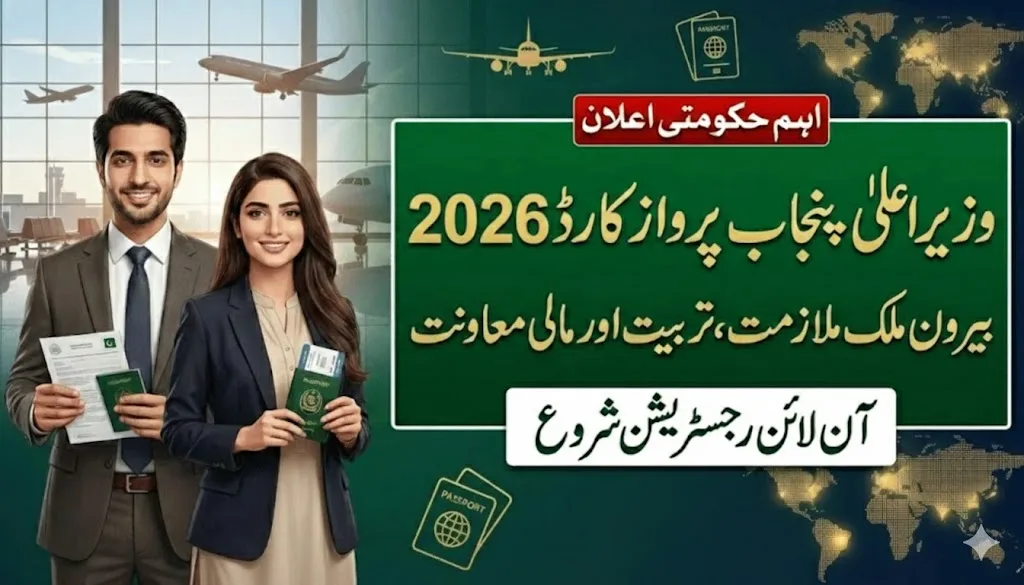
The Parwaz Card CM Punjab Program 2026 represents a transformative government initiative addressing one of Pakistan’s most pressing socioeconomic challenges—youth unemployment and the desperate pursuit of overseas employment opportunities through dangerous, illegal channels. Launched under Chief Minister Maryam Nawaz Sharif’s leadership, this flagship welfare and overseas employment program provides comprehensive support to skilled and aspiring workers seeking legitimate, secure international career pathways.
For hundreds of thousands of Punjab’s youth facing limited domestic job prospects, rising living costs, and family economic pressures, overseas employment offers hope for improved livelihoods and family support. However, the traditional route through unregulated agents often leads to exploitation, financial losses, legal complications, and sometimes tragic outcomes. The Parwaz Card program fundamentally transforms this landscape by providing government-backed preparation, legal documentation support, verified job connections, and protective frameworks ensuring safe, dignified international employment.
This comprehensive program specifically targets low- and middle-income residents of Punjab seeking employment in Gulf countries like UAE, Saudi Arabia, Qatar, Oman, Kuwait, and Bahrain, as well as opportunities in European nations and other international destinations where Pakistani workers are in demand.
For verified information on government programs, welfare initiatives, and important updates, visit 8171 Check Online CNIC – your trusted source for accurate information across Pakistan.
Understanding the CM Punjab Parwaz Card Initiative
The Chief Minister’s Parwaz Card—”Parwaz” meaning “flight” in Urdu—symbolizes the program’s vision of enabling Punjab’s youth to take flight toward international opportunities, improved economic circumstances, and professional growth that domestic markets currently cannot provide at scale.
Program Foundation and Philosophy
The Parwaz Card emerged from recognition of harsh realities facing Pakistani workers seeking overseas employment. Traditional pathways involve paying agents substantial fees—often PKR 300,000 to 800,000 or more—for job placement, visa processing, and travel arrangements. These massive amounts, typically borrowed at high interest or raised by selling family assets, create crushing debt burdens.
Worse, many agents operate without proper licensing, make false promises, provide fraudulent documentation, connect workers with exploitative employers, or simply disappear with advance payments. Victims have limited legal recourse and face financial ruin alongside dashed employment dreams.
Even legitimate agents charge fees beyond most families’ means, effectively excluding talented, hardworking individuals from international opportunities simply due to poverty rather than capability limitations. This systemic barrier wastes human potential while perpetuating poverty cycles.
The Parwaz Card disrupts this exploitative system by providing government-supported pathways that are transparent with clear processes and requirements, merit-based focusing on capability and deservingness rather than wealth, comprehensive covering preparation, documentation, and placement, protective including safeguards against exploitation, and affordable with government subsidizing or covering many costs that typically create barriers.
Core Program Components
The initiative operates across multiple interconnected dimensions, each addressing specific barriers preventing successful overseas employment.
Skills Development Infrastructure: Recognizing that international employers demand specific competencies, the program provides training in high-demand occupational areas through government facilities, vocational institutes, and partner organizations. This ensures participants meet employer expectations and can compete effectively in international labor markets.
Language Training Systems: Communication barriers significantly limit Pakistani workers’ prospects and earning potential abroad. Language courses in English, Arabic, and other relevant languages enhance employability, enable better workplace integration, reduce exploitation risks through improved communication, and create advancement opportunities beyond basic labor positions.
Financial Support Mechanisms: The program provides targeted financial assistance for specific overseas employment costs including passport issuance or renewal, visa application fees and processing, medical examinations required for work permits, skills certification expenses, and in some cases, partial airfare assistance. This support removes financial barriers that prevent capable individuals from pursuing opportunities.
Documentation and Legal Assistance: Navigating complex international employment documentation overwhelms many applicants, leading to errors that cause visa rejections or legal problems. The program provides expert guidance through application processes, document preparation, legal requirements compliance, and verification of employment contracts and employer legitimacy.
Job Placement Facilitation: Rather than leaving participants to find opportunities independently, the program connects approved applicants with verified overseas employers seeking Pakistani workers, licensed recruitment agencies operating ethically and legally, and international job platforms where legitimate opportunities are advertised.
Pre-Departure Orientation: Before traveling abroad, participants receive comprehensive briefings covering destination country labor laws and worker rights, cultural norms and social expectations, avoiding common pitfalls and exploitation, workplace safety protocols, financial management strategies for overseas earnings, and maintaining family connections while abroad.
Comprehensive Program Objectives
The Parwaz Card pursues multiple interconnected goals that benefit individual participants, their families, and broader national interests.
Providing Structured Overseas Employment Support
The primary objective is creating systematic pathways for Pakistani workers to access international jobs through legitimate, safe channels. By handling or supporting preparation, documentation, placement, and protection aspects, the program dramatically increases success rates while reducing risks compared to individuals navigating these complex processes alone or through questionable agents.
Enhancing Workforce Competitiveness
International labor markets are increasingly selective, demanding specific skills, language capabilities, and professional standards. The program’s training components ensure Pakistani workers meet or exceed employer expectations, enhancing their competitiveness against workers from other countries competing for the same positions.
This competitiveness strengthens Pakistan’s reputation as a source of quality labor, potentially opening new markets and improving conditions and compensation for all Pakistani workers abroad as employers recognize enhanced reliability and capability.
Eliminating Exploitation and Fraud
By providing legitimate alternatives to unregulated agents, the program reduces fraud victims, protects vulnerable families from financial devastation, and puts pressure on exploitative agents who lose potential clients to superior government offerings.
The program also educates participants about their rights, warning signs of exploitation, and available recourse if problems arise—knowledge that helps prevent abuse even beyond the program’s direct support.
Promoting Legal Migration Pathways
Illegal migration—overstaying visas, using false documents, working on tourist visas—creates numerous problems including deportation risks, exploitation vulnerability, inability to access legal protections, damage to Pakistan’s international reputation, and barriers to legitimate future opportunities.
The Parwaz Card strongly promotes legal migration by making legitimate pathways more accessible and affordable, demonstrating that legal routes are achievable with proper support, educating about illegal migration risks and consequences, and providing alternatives to desperate measures driven by lack of options.
Strengthening Remittance Flows
Overseas Pakistani workers remit approximately $30-35 billion annually—a crucial foreign exchange source supporting millions of families and stabilizing national finances. By facilitating more Pakistanis’ access to overseas employment, the program potentially increases these vital remittance flows while ensuring workers earn decent wages that enable meaningful family support rather than exploitation-level compensation that generates minimal remittances.
Building Human Capital
Skills training and language education provided through the program create lasting human capital value extending beyond specific overseas employment opportunities. Participants develop capabilities useful throughout their lives in various contexts, enhancing overall workforce quality and economic productivity.
Reducing Domestic Unemployment Pressure
Pakistan’s domestic labor market cannot absorb the hundreds of thousands of young people entering the workforce annually. Overseas employment provides income opportunities that don’t exist domestically, reducing unemployment statistics, easing social pressures from jobless youth, and decreasing competition for limited local positions.
Detailed Eligibility Criteria for Parwaz Card 2026
Understanding eligibility requirements helps potential applicants assess their qualification prospects and enables appropriate preparation if borderline eligible.
Fundamental Eligibility Requirements
Pakistani Citizenship and Valid CNIC: All applicants must hold valid Pakistani citizenship documented through current, unexpired Computerized National Identity Cards. Expired CNICs require renewal before applications can proceed.
Punjab Residency: The program exclusively serves Punjab residents with valid Punjab domicile certificates. This provincial focus reflects Punjab Government funding and administrative responsibility. Residents of other provinces should explore similar programs in their regions if available.
Age Parameters: Standard age limits span 18-45 years, targeting adults legally able to work internationally while excluding those near traditional retirement ages where international employment prospects diminish significantly. The lower bound ensures applicants are adults; the upper bound reflects practical employment market realities.
Some flexibility may exist at boundaries based on skills, experience, and specific employer requirements. A highly skilled 46-year-old with specialized expertise might receive consideration, though standard ranges apply to most applicants.
Educational Minimums: Minimum education requirements vary by occupational category and destination country demands. Basic labor positions may require only Middle school completion (5th or 8th class), while technical roles typically need Matric (10th class) or higher, and professional positions demand intermediate, bachelor’s, or specialized certifications.
These education requirements reflect both employer expectations and program assessments of what education levels enable successful adaptation to overseas employment environments.
Economic Status: The program prioritizes low- and middle-income households for whom overseas employment represents transformative economic opportunity. Very wealthy applicants who could easily afford private agent services don’t align with program objectives of supporting those genuinely needing assistance.
Income verification may involve providing salary documentation, BISP registration status, tax records, or affidavits declaring household income levels.
Serious Intent and Motivation: Applicants must demonstrate genuine commitment to overseas employment rather than casual interest or testing options with no real intention to travel. This commitment assessment occurs through interviews, written statements explaining motivations, and behavior throughout application and training processes.
Officials seek indicators of reliability, responsibility, and determination that suggest applicants will successfully complete preparation, accept job placements, and represent Pakistan positively abroad.
Priority Categories
Certain groups receive enhanced consideration reflecting particular program emphasis or social priorities.
Youth Job Seekers: Young people aged 18-30 without established careers domestically represent prime candidates for building professional futures through international employment. Early career overseas experience can provide financial foundations and skills enabling strong trajectories whether continuing abroad or eventually returning to Pakistan.
Unemployed or Underemployed Individuals: People currently jobless despite actively seeking work, or employed in positions far below their capability and education levels, demonstrate clear need for better opportunities that overseas employment can provide.
Women Seeking Economic Independence: Female applicants pursuing overseas employment opportunities receive special support recognizing cultural barriers women face, the transformative impact of women’s economic empowerment on families, and program commitments to gender inclusion in international employment access.
Skilled Workers: Individuals already possessing relevant technical skills, trade expertise, or professional qualifications through prior training or work experience are prioritized as they require less preparation investment while being immediately employable internationally.
Families with Multiple Dependents: Applicants supporting large families—elderly parents, minor siblings, or other dependents—demonstrate how overseas employment impacts many lives beyond just the worker, creating strong social welfare justification for program support.
Residents of Underdeveloped Districts: People from economically disadvantaged regions where domestic opportunities are particularly limited receive priority as overseas employment represents one of few viable pathways to adequate livelihoods.
Comprehensive Benefits Package
The Parwaz Card provides extensive support covering multiple dimensions of overseas employment preparation and placement.
Free Skills Development Training
Professional training in internationally demanded occupational categories ensures participants meet employer expectations and qualify for positions.
Electrical and Plumbing Trades: Electricians and plumbers remain in high demand across Gulf countries and other destinations for construction, maintenance, and infrastructure work. Training covers electrical systems installation and repair, safety protocols and code compliance, troubleshooting and diagnostic techniques, plumbing systems design and maintenance, and fixture installation and pipe fitting.
Welding and Fabrication: Skilled welders earn premium wages internationally. Training encompasses various welding techniques (arc, MIG, TIG), blueprint reading and technical drawing, metal properties and working methods, safety equipment and hazard management, and quality control and inspection standards.
Mechanical and Automotive Work: Mechanics servicing vehicles, machinery, and equipment are consistently needed. Programs cover engine diagnosis and repair, electrical systems troubleshooting, transmission and brake systems, preventive maintenance protocols, and modern diagnostic technology use.
Driving and Logistics: Professional drivers—particularly for heavy vehicles and specialized equipment—secure stable international employment. Training includes heavy vehicle operation and licensing, defensive driving techniques, cargo handling and logistics, route planning and navigation, and safety regulations and compliance.
Information Technology Support: Growing demand for IT professionals in Gulf markets creates opportunities for technically skilled workers. Training covers network administration basics, hardware troubleshooting and repair, software installation and support, cybersecurity fundamentals, and customer service communication.
Hospitality and Food Service: Hotels, restaurants, and hospitality establishments throughout destination countries employ Pakistani workers. Training includes food preparation and cooking techniques, customer service excellence, hygiene and safety standards, inventory and supply management, and cultural sensitivity in service delivery.
Construction and Building Trades: Carpenters, masons, painters, and other construction workers find abundant opportunities. Programs cover carpentry and woodworking, masonry and concrete work, painting and finishing, construction safety protocols, and blueprint interpretation.
Training delivery occurs through government vocational training institutes, technical education and vocational training authority (TEVTA) facilities, partner private training centers, and on-site practical learning at actual worksites where possible.
Certifications awarded upon completion meet international standards recognized by employers abroad, enhancing credential value and employability.
Language Course Provision
Communication capability dramatically affects overseas employment success, workplace integration, exploitation vulnerability, and advancement prospects.
English Language Training: English serves as the primary business language across most international employment destinations. Courses develop workplace communication skills, technical vocabulary relevant to specific trades, basic literacy for document reading and form completion, and conversational ability for daily interactions.
Training levels range from basic (for those with minimal English) to intermediate (building on existing foundations) to advanced (for professional positions requiring fluent communication).
Arabic Language Training: Given major employment markets in Arabic-speaking Gulf countries, Arabic language capability provides significant advantages. Training focuses on conversational Arabic for daily life, workplace terminology and commands, cultural communication norms, and basic reading for signs and documents.
Many Pakistani workers function with minimal Arabic, but those possessing even moderate skills earn better positions, avoid misunderstandings, integrate more successfully, and access advancement opportunities.
German and Other Languages: For employment opportunities in Germany, Austria, and other European destinations requiring specific language proficiency, specialized training helps meet visa and employer requirements.
The specific languages offered vary based on destination country priorities and program partnerships—demand and opportunity patterns influence language training allocation.
Financial Assistance Mechanisms
While the program cannot cover all overseas employment costs, targeted financial support addresses key barriers preventing capable individuals from pursuing opportunities.
Passport Services Support: New passport applications or renewals for expired documents cost approximately PKR 3,000-16,000 depending on urgency and page count. The program may cover or subsidize these costs for approved participants who lack funds for this essential documentation.
Visa Application Fee Assistance: Work visa fees vary by destination country—typically ranging PKR 15,000-50,000 or more. Programs may provide partial or complete fee coverage depending on participant circumstances and program budget allocations.
Medical Examination Coverage: Most destination countries require medical fitness certificates for work permits, involving examinations costing PKR 5,000-15,000. Program support ensures these mandatory requirements don’t become barriers.
Skills Certification Expenses: Obtaining official certifications or trade licenses required by employers or destination countries involves examination and documentation fees that program support can cover.
Airfare Assistance: In some cases, particularly for highly skilled workers or placements in countries with upfront travel expectations, programs may provide partial airfare support—often structured as interest-free loans repayable from initial overseas earnings.
The exact financial support provided depends on individual circumstances, destination requirements, and program budget availability—not all participants receive all possible assistance categories.
Documentation and Legal Guidance
Expert assistance navigating complex international employment paperwork dramatically increases success rates while reducing stress and confusion.
Visa Application Support: Specialists guide participants through destination-specific visa processes including form completion, supporting document preparation, embassy submission procedures, interview preparation when required, and tracking application status.
Employment Contract Review: Before participants commit to positions, program legal advisors review contracts ensuring terms are reasonable and legal, compensation meets destination country minimum standards, working conditions comply with labor laws, termination and dispute resolution clauses are fair, and no exploitative provisions exist.
Document Authentication: Many documents require official attestation or authentication—birth certificates, education credentials, police clearances, and other materials. Guidance through attestation processes with Ministry of Foreign Affairs and relevant embassies ensures proper documentation.
Pre-Departure Compliance: Final checks before travel confirm all documentation is complete and correct, visas and permits are valid for intended travel dates, medical certificates are current, and no missing elements will cause airport or arrival complications.
Job Placement and Employer Connections
Connecting prepared participants with legitimate employment opportunities represents the program’s culmination.
Verified Employer Database: The program maintains relationships with international employers seeking Pakistani workers who meet specific criteria. These relationships ensure employer legitimacy, job offer authenticity, and reasonable terms.
Licensed Recruitment Agency Network: Rather than participants randomly selecting agents, the program connects them with government-verified recruitment agencies that operate legally, maintain proper licenses, demonstrate ethical conduct history, provide transparent cost structures, and offer contract clarity and protections.
Job Matching Services: Based on participant skills, preferences, and qualifications, program coordinators match individuals with appropriate opportunities rather than generic placement approaches.
Ongoing Employer Relationship Management: The program doesn’t end at placement—ongoing contact with employers monitors participant performance, addresses workplace issues, ensures contract compliance, and maintains relationships supporting future placements.
Pre-Departure Orientation Programs
Comprehensive briefings prepare workers for overseas experiences, reducing culture shock and increasing success likelihood.
Destination Country Information: Detailed orientation about the specific country where participants will work covers cultural norms and social expectations, religious practices and sensitivities, climate and living conditions, cost of living and financial considerations, legal system basics and worker rights, and communication norms and language basics.
Labor Rights Education: Participants learn their legal rights under destination country labor laws, how to recognize exploitation or rights violations, available complaint mechanisms and support resources, and when to seek embassy or program assistance.
Workplace Safety Training: Basic occupational safety principles relevant to specific trades reduce injury risks that could end careers or cause serious harm. Training emphasizes personal protective equipment use, hazard recognition, emergency procedures, and refusing unsafe work.
Financial Management Guidance: Many workers struggle managing overseas earnings effectively. Training covers budgeting and expense tracking, remittance methods and cost comparisons, savings strategies, avoiding common financial pitfalls, and planning for eventual return to Pakistan.
Cultural Adaptation Support: Psychological preparation for culture shock, homesickness, and lifestyle adjustment increases resilience and reduces premature returns or abandonment of opportunities.
Family Connection Maintenance: Strategies for staying connected with families through affordable communication, managing family relationships across distance, and balancing financial support with personal needs.
Read More: CM Free Solar Scheme 2026 Result Announced
Online Registration Process for Parwaz Card 2026
Successfully applying requires understanding each registration stage and properly preparing required information and documentation.
Step 1: Accessing Official Registration Portal
Begin by locating the authentic Parwaz Card registration portal through verified government channels—the official Punjab Government website, Chief Minister’s Office official platforms, or announcements from relevant provincial departments.
Critical Security Warning: Fraudulent websites impersonate government portals to collect personal information for identity theft or to charge illegal fees for services that should be free. Always verify you’re on authentic government domains with official .gov.pk extensions and proper government branding. Never access portals through unverified links in SMS, social media, or random websites.
Step 2: Account Creation and Verification
The registration begins with creating a unique account tied to your CNIC.
Enter your 13-digit CNIC number exactly as shown on your card without dashes or spaces unless specifically required. Provide your active mobile number registered with NADRA—the system sends verification OTP codes to this number.
Enter the received OTP to confirm mobile number ownership and create a secure password following system requirements (typically 8+ characters mixing uppercase, lowercase, numbers, and symbols).
Step 3: Personal Information Completion
Complete comprehensive forms collecting necessary data for eligibility verification and assessment.
Provide full legal name matching CNIC, father’s name, date of birth, gender, complete current address with all details, permanent address if different, contact numbers, and email address if available.
Enter educational background including highest qualification completed, institution names, passing years, and technical certifications or specialized training.
Describe current employment status, occupation, monthly income, household size, and number of dependents.
Step 4: Overseas Employment Preferences
Specify your preferences for overseas work to help matching with appropriate opportunities.
Indicate preferred destination countries (Gulf states, Europe, other regions), preferred occupational categories based on your skills and interests, acceptable salary ranges, and willingness to accept different position types or locations.
Explain your motivation for overseas employment and what you hope to achieve through international work experience.
Step 5: Skills and Experience Documentation
Detail your existing skills, training, and work experience relevant to overseas employment.
List technical skills with proficiency levels, language capabilities, prior work experience with duties performed and duration, certifications or licenses held, and special qualifications that enhance your employability.
Step 6: Required Document Uploads
Upload clear, legible scans or photos of all required documents:
- CNIC front and back
- Recent passport-size photographs
- Punjab domicile certificate
- Educational certificates
- Skill certification documents
- Passport copy (if already holding passport)
- Income proof or BISP documentation
- Any other supporting materials
Ensure files meet size and format requirements while remaining clearly readable.
Step 7: Application Review and Submission
Before submitting, carefully review all entered information for accuracy. Errors can cause rejections or delays.
Read and accept terms and conditions, certify information accuracy, and understand penalties for false information.
Submit your completed application and save your unique tracking ID for status checking.
Step 8: Post-Submission Process
After submission, your application undergoes verification and assessment. Log in periodically to check status updates and respond promptly to any requests for additional information.
Shortlisted applicants receive notifications for screening tests, interviews, or skills assessments to determine final selection and appropriate placement.
Essential Documents Checklist
Proper documentation is critical for application success.
National Identity Card: Original valid CNIC proving citizenship and identity.
Passport: Current passport if you have one; applications for new passports can proceed after selection.
Recent Photographs: Multiple passport-size photos meeting standard requirements.
Domicile Certificate: Valid Punjab domicile proving provincial residency.
Educational Certificates: Matric, Middle, or higher education credentials.
Skill Certifications: Technical training completion certificates or trade licenses.
Income Documentation: Salary certificates, BISP cards, or income affidavits establishing economic status.
Character References: Letters from credible community members attesting to your character and reliability may strengthen applications.
Strategic Importance for Punjab Youth
The Parwaz Card addresses critical challenges facing young Pakistanis while creating broader social and economic benefits.
Creating Safe Alternatives to Dangerous Migration
Desperate circumstances drive many to attempt illegal migration—traveling on fake visas, overstaying tourist permits, using smuggling networks, or working without authorization. These paths involve enormous risks including deportation and lifetime bans, exploitation by smugglers or employers, inability to access legal protections, separation from families with no return path, and sometimes death during dangerous journeys.
The Parwaz Card provides legitimate alternatives that are safer, more likely to succeed, and create sustainable rather than temporary situations.
Protecting Against Agent Fraud
Countless families have been devastated by fraudulent agents who collected huge sums promising overseas jobs that never materialized. The resulting debt destroys families financially while crushing hopes for improved circumstances.
Government-supported pathways eliminate this vulnerability by providing transparent, accountable processes where families can verify legitimacy without depending on trust in potentially fraudulent intermediaries.
Enhancing National Reputation
Pakistani workers’ international reputation directly affects future employment prospects for all Pakistanis. Well-trained, professional, reliable workers strengthen perceptions of Pakistani labor quality, potentially opening new markets and improving terms for everyone.
Conversely, poorly prepared workers who underperform or encounter problems damage reputation, making it harder for future workers to secure opportunities.
Generating Sustainable Family Income
Overseas employment typically provides monthly earnings 3-5 times what workers could earn domestically for similar work. These remittances transform family economic circumstances through improved housing and living standards, children’s education investments, healthcare access, debt repayment, savings accumulation, and even business investments creating additional income sources.
Building Professional Skills and Experience
International work exposure develops capabilities and experience valuable even if workers eventually return to Pakistan. Skills learned, work discipline, exposure to modern practices, and international work history on résumés all enhance future prospects.
Program Expansion and Future Directions
Current program operations represent initial phases with significant expansion planned.
The Punjab Government aims to support approximately 100,000 workers through various program components over coming years. Success will depend on sustainable funding, strong employer relationships, effective training delivery, and successful outcomes for initial participants building positive reputation.
Future plans include potential expansion to other provinces through federal partnership or provincial replication, enhanced online and remote training options for rural residents, increased international employer partnerships broadening destination options, and alumni networks supporting past participants while mentoring new ones.
Frequently Asked Questions
Is Parwaz Card registration completely free?
Registration and assessment are free. However, some costs may apply for specific services beyond basic program coverage—these are clearly communicated and significantly subsidized compared to private agent charges.
Does Parwaz Card only support overseas employment or also domestic jobs?
The program’s primary focus is facilitating international employment, though skills training provided has value for domestic opportunities as well.
Can women apply for Parwaz Card opportunities?
Absolutely. Women are actively encouraged to apply, with special support recognizing barriers women face in accessing overseas employment.
Does program participation guarantee overseas job placement?
No program can guarantee employment as ultimate placement depends on employer decisions, market conditions, and individual performance. However, the program dramatically improves prospects through comprehensive support.
What happens if I’m selected but change my mind about going abroad?
You’re not obligated to accept placement, though program spaces are limited and declining wastes opportunities others could use. Serious intent assessment aims to prevent this scenario.
How long does the entire process take from application to departure?
Timelines vary significantly based on destination country processing speeds, training duration required, and job availability. Expect several months minimum from application to actual departure.
For comprehensive information on this and other government programs, visit 8171 Check Online CNIC – your trusted resource for verified updates.
The Parwaz Card CM Punjab Program 2026 offers transformative opportunities for Punjab’s youth seeking international careers. If you’re motivated, capable, and need support accessing overseas employment, register today and take the first step toward a secure global future.